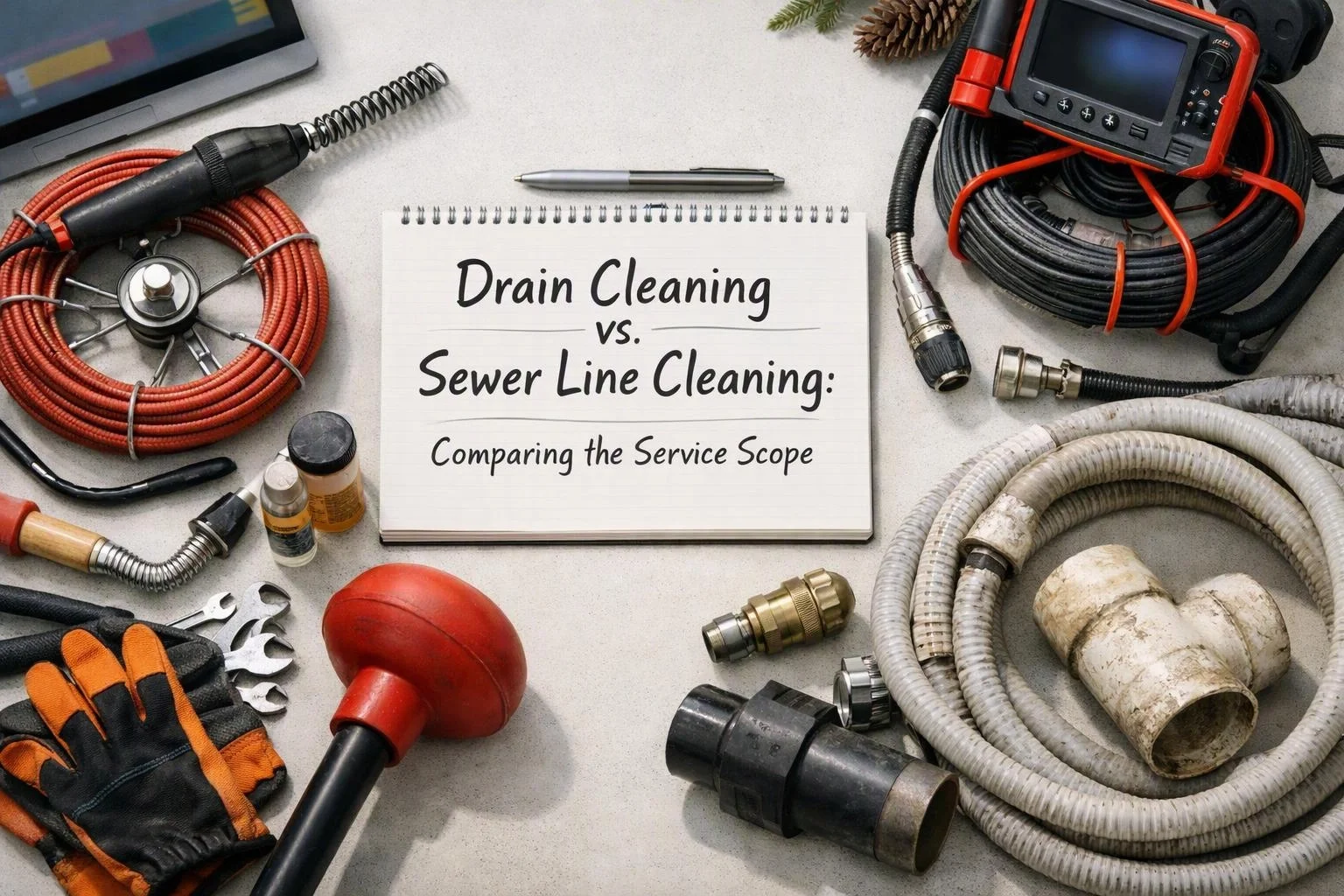
Drain Cleaning vs. Sewer Line Cleaning: Comparing the Service Scope
Drain cleaning clears blockages in individual fixtures or branch pipes, while sewer line cleaning addresses the main waste pipe serving the property. PlumbingAuburnwa.com compares the scope, warning signs, cost drivers, and best use for each service.
Request an EstimateHow Drain Cleaning and Sewer Line Cleaning Differ
Drain cleaning targets a local drain or branch pipe, while sewer line cleaning targets the main pipe carrying wastewater from the property.
A fixture drain serves one sink, shower, bathtub, or toilet. A branch drain combines flow from several fixtures before it reaches the main sewer line. The blockage location helps determine the right service scope.
Our team uses the affected fixtures and backup pattern to narrow down that location. A single clogged drain often points to a local obstruction. Several affected drains can point to a main-line problem.
Drain Cleaning vs. Sewer Line Cleaning at a Glance
Drain cleaning usually fits an isolated fixture problem, while sewer line cleaning fits symptoms that affect multiple drains or the main waste route.
Both services remove obstructions, but the access point and equipment can differ. The table shows how the options compare without assuming that one service fits every blockage.
| Factor | Drain Cleaning | Sewer Line Cleaning |
|---|---|---|
| Service scope | One fixture drain or branch drain | Main sewer line, building sewer, or lateral sewer |
| Cost drivers | Access, blockage severity, and cleaning method | Access point, pipe condition, obstruction type, and inspection needs |
| Timeline | Usually a more focused cleaning visit | Can require broader access, flow testing, or camera inspection |
| Maintenance | Addresses localized buildup and recurring fixture clogs | Addresses main-line buildup and shared backup patterns |
| Best use | Localized clog or single-fixture problem | Main line blockage or multiple-drain backup |
What Drain Cleaning Covers
Drain cleaning clears a sink drain, shower drain, bathtub drain, toilet drain, or branch drain that has a localized blockage.
Our crew first considers which fixture is affected and how the water moves. We may use a drain snake or mechanical auger to break through a localized obstruction and restore flow.
For a focused drain problem, our drain cleaning service addresses the accessible pipe section. A repeat clog may need a drain inspection to identify buildup or a deeper pipe issue.
Why Choose Drain Cleaning for a Local Clog
A single affected fixture usually supports a localized cleaning approach. The pattern helps our team avoid treating the main sewer route when the obstruction sits closer to the fixture.
Best for: Drain cleaning is best for a localized clog that stays limited to one fixture or branch drain.
What Sewer Line Cleaning Covers
Sewer line cleaning clears an obstruction in the main sewer line, building sewer, or lateral sewer carrying wastewater away from the property.
Our team looks for shared drain symptoms because several fixtures may depend on the same waste route. Root intrusion, grease buildup, and other pipe obstructions can restrict wastewater flow in that route.
We use the available sewer cleanout or another suitable access point when reaching the main line. The cleaning method depends on the pipe condition, obstruction, and access.
Why Choose Sewer Line Cleaning for Main-Line Symptoms
Several connected symptoms suggest that the blockage may sit in the main sewer route. A focused fixture cleaning may not clear a shared obstruction.
Best for: Sewer line cleaning is best for a main line blockage that affects multiple fixtures or causes a sewer backup.
Which Service Fits the Problem?
Choose drain cleaning for one affected fixture, and choose sewer line cleaning when several fixtures share the same backup pattern.
Our team compares the drain symptoms, blockage pattern, and fixture isolation before choosing a cleaning method. A drain inspection can help when symptoms do not clearly identify the blockage location.
Stop using water when wastewater is backing up into fixtures. Contact our team when the backup spreads, returns, or includes sewer odor.
When One Fixture Points to Drain Cleaning
A single affected fixture usually points to drain cleaning when nearby fixtures drain normally.
A slow sink, shower backup, or toilet blockage can sit in the fixture drain or branch pipe. Our crew checks the local symptoms before deciding whether the main sewer route also needs attention.
When Several Fixtures Point to Sewer Line Cleaning
Several affected fixtures point to sewer line cleaning when wastewater backs up through the lowest drain.
The lowest drain often shows a shared blockage first because wastewater cannot pass through the main sewer route. Our team checks the sewer cleanout and related flow symptoms before recommending further work.
What Changes the Cost and Work Time?
The job's cost and work time depend on access, blockage location, pipe condition, cleaning method, and whether inspection is needed.
An easy access point can support a more focused visit. Difficult access, a long pipe section, severe blockage, root intrusion, or a repeat blockage can require more equipment and added investigation.
Pipe condition also matters. Our team explains what the quote includes, such as access work, cleaning, flow testing, and any recommended camera inspection. We provide an exact quote after reviewing the problem and service scope.
What Our Cleaning Process Checks
Our cleaning process starts with the symptoms and ends with a flow check and clear quote.
When Cleaning May Not Solve the Sewer Problem
Cleaning may not resolve a damaged sewer line because removal of the blockage cannot restore broken, collapsed, or misaligned pipe.
A collapsed sewer pipe, cracked pipe, or bellied pipe can continue to restrict flow after cleaning. Severe root intrusion may also return when roots have entered damaged pipe joints.
Our team may recommend a camera inspection before discussing pipe replacement or trenchless repair. A recurring blockage is a warning that the pipe needs more than repeated cleaning.
How to Prepare for a Drain or Sewer Cleaning Visit
Preparing the affected fixtures and backup history helps our team identify the likely blockage location.
Note which fixtures drain slowly, when the problem started, and whether wastewater reaches a low drain. Share any past cleaning or repair details that may explain a recurring backup.
Keep the cleanout location accessible when possible. Clear safe access around affected fixtures, and avoid using water if wastewater is backing up.
Call our team when the symptoms involve multiple fixtures, sewer odor, yard seepage, or repeated backups. We can review the problem and explain the next service step.
Questions About Drain and Sewer Cleaning
Can a drain cleaning clear a sewer line blockage?
Yes, drain cleaning can clear a sewer line blockage only when the equipment reaches that blockage and suits the pipe. Our team checks the access point, blockage location, and pipe condition before choosing the cleaning method.
How can you tell if a clog is in the main sewer line?
Multiple slow drains, a lowest-drain backup, gurgling fixtures, or a recurring sewer backup can indicate a main sewer line clog. Our team confirms the likely location through fixture testing, access checks, and flow testing.
Does sewer line cleaning remove tree roots?
Yes, sewer line cleaning can remove some root intrusion from the pipe, but cleaning cannot repair pipe damage that lets roots return. Our team may recommend a camera inspection when roots or recurring blockage are present.
When does a recurring clog need a sewer camera inspection?
A recurring clog needs a sewer camera inspection when cleaning provides only temporary relief or several fixtures keep backing up. The camera can help reveal root intrusion, a collapsed pipe, a crack, or another pipe obstruction.
Can sewer line cleaning prevent future backups?
Sewer line cleaning can reduce future backups when buildup causes the blockage, but it cannot prevent problems from damaged or misaligned pipe. Our team uses flow testing and inspection findings to explain whether cleaning or repair better fits the sewer line.
Contact our team for a quote based on the blockage location, access point, pipe condition, and required cleaning method.